
NVIDIA GTX 960 4GB Graphics Card
Inclusive of all taxes
Full details of the NVIDIA GTX 960 4GB graphics card—with Maxwell 2.0 architecture, 1024 CUDA cores, more VRAM, and G-Sync support. Learn about features, specifications, new and used market prices.


I've set it up to run multiple containers and VMs lik …more
NVIDIA's GTX 960 4GB is the same card from the GTX 960 series launched in January 2015, but board partners (MSI, EVGA, Gigabyte, ZOTAC) offered it with more video memory. It's important to understand here – this 4GB variant wasn't part of NVIDIA's official reference design, but rather was marketed by board partners themselves with double the memory chips. This means that the GPU cores, memory bus width, and bandwidth remain exactly the same as the 2GB variant, with only double the VRAM capacity.
So where's the advantage? In games or tasks that require more than 2GB of VRAM—like high-resolution texture-packed games, or during multitasking—the 4GB variant can reduce stuttering and provide a smoother experience. But if the game doesn't use more than 2GB of VRAM, there's no significant difference in performance, as the bottleneck is really memory bandwidth and GPU power.
Performance and Architecture
This card is also built on the Maxwell 2.0 architecture (GM206 chip) and a 28nm process. It features 1024 CUDA Cores, 32 ROPs, and 2MB of L2 cache. The base clock is around 1127 MHz, and the boost clock ranges from 1178 MHz to 1304 MHz depending on the model—some factory-overclocked variants (like the MSI Gaming 4G) offer even higher clock speeds.
Support for DirectX 12 (Feature Level 12_1), OpenGL 4.5, and Vulkan makes this card compatible with many modern games. NVIDIA GPU Boost 2.0 technology automatically adjusts clock speeds based on load, balancing performance and power efficiency.
Power consumption for this card is also around 120W, and most models require a 6-pin or 8-pin power connector. The recommended power supply is 400W.
Memory and memory bandwidth
This card features 4GB of GDDR5 video memory, running at an effective speed of 7010 MHz over a 128-bit memory interface. Memory bandwidth remains the same as the 2GB variant, at approximately 112 GB/s, as the memory bus width and speed remain unchanged, only the number of memory chips has been increased.
Display Output and Connectivity
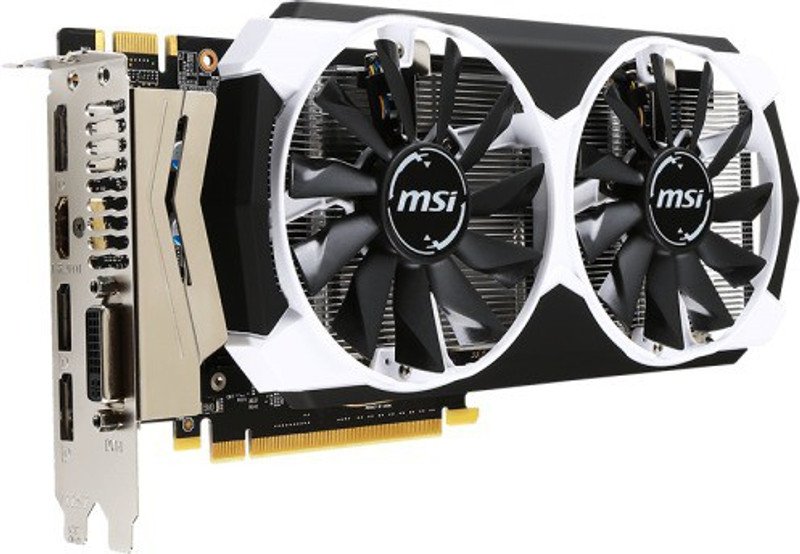
The GTX 960 4GB features Dual-Link DVI, HDMI 2.0, and DisplayPort 1.2 (multiple DisplayPort outputs on some models). The card supports up to four monitors and can output digital resolutions up to 5120x3200. The PCI Express 3.0 x16 interface makes it easily compatible with any modern motherboard, and 2-Way SLI support is also available.
Cooling and Build
Since this card has more memory chips, the card's size and weight are slightly larger than the 2GB variant (around 24cm-27cm in length). Most variants feature dual-fan cooling solutions — MSI's Twin Frozr, Gigabyte's WindForce 2X, and EVGA's ACX coolers have been popular in this series, keeping the card cool and silent even under heavy loads.
Things to keep in mind during installation
Ensure the card is properly seated in the PCIe x16 slot and the power connector is connected, whether it's a 6-pin or 8-pin one. The PSU should be at least 400W. Since this is an older card, download the driver from NVIDIA's legacy driver list. When purchasing, keep in mind that sometimes locally assembled cards labeled as 4GB are actually sold with fake memory badges. So, choose branded models (MSI, EVGA, Gigabyte, ZOTAC) and verify the memory with a tool like GPU-Z.
Who is this graphics card for?
The GTX 960 4GB is ideal for users who play texture-heavy games or require more VRAM while multitasking. If your usage is limited to light esports titles, the 2GB variant is sufficient and will be cheaper. However, for those who want a little future-proofing or want to play games packed with high-resolution textures, the 4GB variant will be better.
GTX 960 4GB Specifications Table
| Specification | Details |
|---|---|
| GPU Architecture | NVIDIA Maxwell 2.0 (GM206) |
| Manufacturing Process | 28nm |
| CUDA Colors | 1024 |
| Base Clock | ~1127 MHz (varies by brand) |
| Boost Clock | ~1178-1304 MHz |
| Video Memory | 4GB GDDR5 |
| Memory Interface | 128-bit |
| Memory Clock | 7010 MHz (Effective) |
| Memory Bandwidth | ~112GB/s |
| Interface | PCI Express 3.0 x16 |
| Display Outputs | Dual-Link DVI, HDMI 2.0, DisplayPort 1.2 |
| Max Displays | 4 Monitors |
| Max Resolution | up to 5120x3200 |
| Power Consumption | ~120W |
| Recommended PSU | 400W |
| Power Connector | 6-pin or 8-pin (depending on model) |
| Multi-GPU Support | 2-Way SLI |
| Special Features | NVIDIA G-Sync, GPU Boost 2.0, MFAA, DSR |
| DirectX Support | DirectX 12 (Feature Level 12_1) |
| OpenGL/Vulcan | OpenGL 4.5, Vulkan Supported |
| Cooling | Dual-Fan (model dependent) |
| Ideal For | Heavy texture games, 1080p medium-high settings, multitasking users |
GTX 960 4GB Price (New vs Second-Hand)
| Type | Price Range |
|---|---|
| New (if available) | This card has also been discontinued from the market; some online resellers are selling old stock for between ₹14,000 – ₹20,000, which is much higher than the original MSRP. |
| Second-hand/used market | Approximately ₹6,000 – ₹8,500 (depending on condition, brand and warranty status) |
Note: This card sells for slightly more than the 2GB variant because it has more VRAM, even though bandwidth and performance are roughly the same. This is the most common way to find this card on the second-hand market. Before purchasing, be sure to verify the memory size with a tool like GPU-Z and have the card's condition tested.
Abhi tak koi review nahi hai — sabse pehle aap review karein!
Login karke review likhein.
🚚 Delivery: 3–5 business days
💰 Free delivery on orders above ₹3,000
📢 Get 5% Off On ₹10,000 Above Purchase
Use This Coupon 😊 ADCENEW5
🔒 100% Secure Transaction
Sold by: Adce
Ships from: 140 - Ananda Pally. Paschim Putiary. Kolkata. West Bengal 700093
Payment: COD Available